

the customized automation solution
Vimotech realizes
Predictive Maintenance
Prevent equipment failures by detecting even the smallest changes in machine condition at an early stage.
What we do
Detect Equipment Failures Before They Occur
Mechanical wear, damaged components, or emerging defects rarely lead to an immediate shutdown. In many cases, changes first become visible in cycle times, motion sequences, temperatures, vibrations, or resource consumption – often so subtle that they remain unnoticed by operators.
We use existing machine and sensor data to make these changes visible at an early stage. Relevant process variables are selected, structured, analyzed, and combined. Depending on the application, we use threshold monitoring, pattern recognition, or model-based analysis.
This allows potential failures to be addressed during planned maintenance shutdowns instead of occurring unexpectedly during production.
Your benefits:
- fewer unplanned machine stoppages
- greater production and process reliability
- earlier planning of maintenance and spare parts
- more stable product quality
- greater transparency regarding performance, wear, and resource consumption
The goal: No unexpected failures during operation – by detecting even the smallest changes in machine condition at an early stage.

Motivation
Maximum Process Control
Mechanical wear, minor damage, and defective components usually do not cause an immediate machine failure. Over time, however, their condition deteriorates and the probability of failure increases significantly. During this phase, product quality may already begin to decline.
Industrial systems contain a large number of components whose probability of failure increases with operating time. Taken together, these individual risks can result in frequent disruptions and reduced overall system availability.
ACtion instead reaction
Avoid standstill
Unfortunately, these failures often occur at the most inconvenient or production-critical times. Ideally, potential faults are identified early enough to be addressed in a controlled manner during scheduled maintenance shutdowns.
Early detection of equipment failures provides numerous benefits:
- Reliable production
- Better maintenance planning
- Efficient spare parts management
- Permanent solutions instead of temporary fixes

AI generated

Analyse process
Even the smallest mechanical changes, such as wear or emerging defects, often remain unnoticed by operators and may not yet have any measurable impact on production performance.
Long before an actual failure occurs, however, subtle changes in the process can already be detected. These changes can often be captured using existing machine data from the PLC or industrial PC and evaluated systematically.

Define sensors
The required sensors are often already available, as they are necessary for operating the machine.
However, the relevant sensor data must be selected and filtered appropriately and, where necessary, additional sensors can be integrated to capture the required information.

Apply algorithm
your industry, our expertise
Target group-oriented automation solutions from Vimotech
Steel and aluminum production
Automotive
Aerospace
Packaging industry
The Data Is There – Use It!
Monitoring Process Variables
Even the smallest changes in process variables can provide valuable indications of an impending failure.
- Cycle and movement times
- Changes in motion behavior, such as acceleration or smoothness
- Resource consumption
- Vibrations
- and many more
The analysis of machine deviations is also becoming increasingly important in mechanical and plant engineering. User interfaces should no longer support operators only during troubleshooting, but also provide early warnings before a failure occurs.
The key challenge is the reliability and accuracy of these predictions. If a system continuously generates unjustified warnings and alarms, operators will eventually stop taking them seriously. In that case, even a correctly detected fault may simply be acknowledged and ignored.
Large industrial systems generate extensive amounts of sensor data, but only a portion of it actually contributes to preventing failures. Therefore, only the data that is relevant to machine condition and early fault detection should be selectively acquired, stored, and analyzed. This not only supports stable and reliable machine operation, but also provides valuable transparency regarding performance, optimization potential, and opportunities for reducing resource consumption.
To draw conclusions from machine behavior retrospectively, the relevant data must be stored when a fault occurs. However, too much data can be just as useless as having no data at all. Reducing information to what is truly relevant is therefore essential throughout the entire process.
Quality Over Quantity
Machine Data Management
As Little as Possible – As Much as Necessary
Algorithm – Threshold Values
Monitoring threshold values for cycle times, temperatures, movements, and other process variables has become a basic requirement in modern machine engineering. However, careful definition of these thresholds is essential for detecting faults at an early stage. In practice, thresholds are often set so broadly that an alarm is triggered only when a component is already close to actual failure. Tighter limits are frequently avoided in order to prevent unnecessary alarms during commissioning.
Threshold-based monitoring is simple, robust, and cost-effective. However, it provides only limited information about the actual cause of a fault and does not account for the natural wear and gradual deterioration of a machine over time.
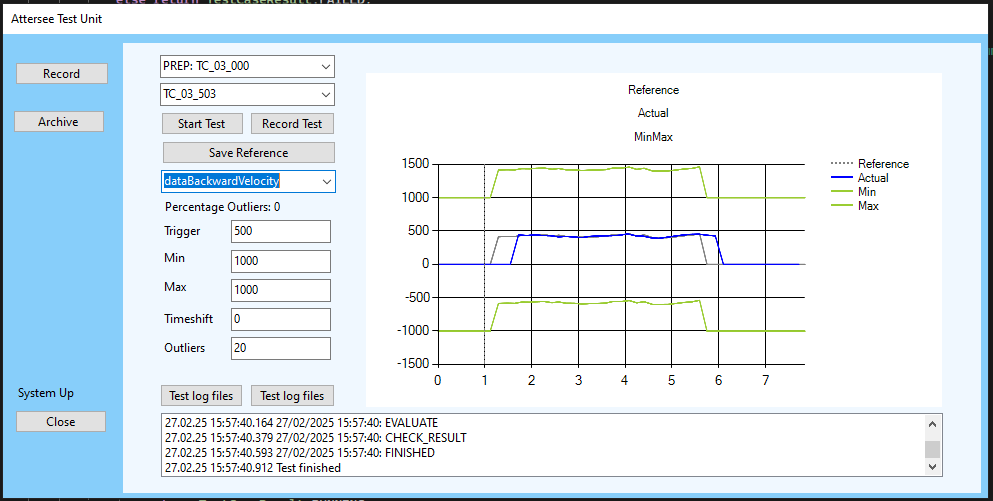
Mechanical defects can occur in any moving system. These may become noticeable as increased resistance, uneven motion, or jerking. Monitoring cycle time alone often provides insufficient information and can therefore lead to incorrect predictions.
In such cases, the entire motion profile is analyzed and compared with normal operating behavior. By systematically storing and evaluating the relevant measurement data, it may also be possible to draw conclusions about the underlying cause of a detected deviation.
Examples of pattern-based analysis include:
- Abnormal motion profiles
- Detection of bearing damage
- Defective heating elements
- Blocked pipes or irregular flow behavior
- and many more
Never touch a running system
Algorithm – Pattern Recognition
Yes! But why?
Algorithm – Simulation

Comparing machine values with model data is similar in principle to fault detection through pattern recognition. The key advantage, however, is that the expected machine behavior is defined in advance based on a theoretical or physical model. This makes it possible not only to detect deviations, but also to draw conclusions about their specific root cause.
Industrial plants often contain several identical or similar units. By characterizing and modeling a single component, the behavior of a much larger part of the system can often be described and monitored efficiently.
The Vimotech concept for success
Measuring & testing technology taken further
Robustness and durability as well as flexibility and adaptability
The devices must be able to withstand the demanding conditions in industrial environments, such as high temperatures, humidity, vibrations and chemical influences. Furthermore, the technology should be easy to integrate into different applications and systems and be able to adapt to changing requirements.
Data acquisition and analysis
In addition to the acquisition of measurement data, the analysis and interpretation of this data is also of crucial importance. Advanced analysis tools can help to detect patterns, identify anomalies and reveal optimization potential.
Conformity and certification - integration of Industry 4.0 technologies
Especially in regulated industries such as the steel and aluminum industry, it is important that the measurement technology complies with the applicable norms and standards and possibly has certifications such as ISO 9001 or NADCAP approvals. The integration of Industry 4.0 technologies such as IoT (Internet of Things), artificial intelligence and machine learning enables even more intelligent and predictive use of measurement and testing technology in automation.